








Learn


Gong-Fu Cha - The Complete Guide To Making Chinese Tea - By Daniel Lui

Gong-Fu Cha - The Complete Guide To Making Chinese Tea - By Daniel Lui

This guide will introduce you to the Chinese method of tea-making, called "Gong Fu Cha" - "Tea With Great Skill". Unlike wine drinkers who learn about vines and vintages, the tea-maker must make what they drink, which requires not just knowledge but skill in selecting and using their tools. With the information presented in this guide, one can progress quickly to an advanced stage of tea-making in this traditional and ancient art.
Why All The Fuss For A Cup Of Tea?
When I first moved to North America from Hong Kong, local friends would invite me to their homes for tea. I would watch them bring out their large teapot, throw in some tea leaves, add boiling water and let the leaves steep until the brew was very strong. When the tea got too strong, they would simply add more water and repeat the process until the leaves had no more flavour. They were surprised to learn that this is how most Chinese drink tea as well!
While most Chinese are aware of Gong Fu Cha as part of their cultural history, few actually know how it is done. The modern Gong Fu style of tea-making is essentially about controlling all the variables of tea-making with a high degree of precision and consistency. In this way it is possible to get the maximum flavour consistently from the maximum number of brews that a tea can make. It is not a ceremony as with the well known Japanese Cha No Yu tradition with all its symbolism, but a procedure of practical steps where everything involved has a functional purpose to make a tea taste as good as possible.
Even so, Gong Fu Cha is as much about escaping the pressures of life for a few moments as it is about enjoying every drop of tea. The first thing a Westerner will notice is the teacups are very small. This approach to tea-making with such attention to detail and savouring every drop is different from western notions, but as an art that has been perfected over many hundreds of years, the result is a relaxing and enjoyable environment alone or with friends and tea that tastes better than you’ve ever tasted before. With many Chinese teashops now opening and with wide access to the internet, tea knowledge, good quality tea and tea accessories are more widely available than ever before, so anyone from anywhere can learn this ancient skill with just a little practice!
So let’s jump right in. At the basic level, there are 5 variables involved:
- Quality Of The Tea
- How Much Tea Do I Use?
- Temperature Of The Water
- Brewing Times
- The Quality and Type Of Teapot
At a more advanced level, add:
- Selecting a Teapot
- Advanced Brewing Technique
- Quality of Water
- Seasoning a New Teapot
Quality Of The Tea
As the economy of China has grown, so has its tea industry. In the late 1990’s there were relatively few tea manufacturers. Ten years later there are thousands! Unfortunately the number of tea growers has not increased at the same rate, so there is a lot of second rate product on the market. In some large tea shops, tea is marketed and retailed much like any other product and many people working there have little training about what makes high grade tea. They simply have, like any other retail store, products that range in price from low to high. From a store’s perspective, their most expensive tea is “high grade tea”. This may or may not be true but until you have developed your skill at identifying tea leaves, you can only know for sure by comparing teas of different prices and from different sources. One thing is for certain. Chinese teas come in some of the most beautiful packaging you have ever seen, but this is no indication of the quality. In fact, it is often the opposite.
There are 3 reasons for selecting the best grade of tea you can find. It tastes better, lasts longer and is more cost-effective in the long run. High grade tea will last 6 – 10 brews with consistent flavour depending on how strong you like your tea. Poor quality tea may taste good on the first or second brew but after that there is little taste left, so you just end up using more tea. The better tea shops will always make a tea for you before you buy. Make sure to taste the fourth or fifth brew to really see what you are getting and pay attention to how it is being made. You can even ask them to follow the same brew times you use. Try to get a sample or buy the smallest quantity you can for a new tea.
Chart: Quality Of Leaves By Tea Type
| High Quality Leaves | Low Quality Leaves | |
| Black (known as Red Tea in China) |
 |
 |
| Green |
 |
 |
| White |
 |
 |
| Oolong |
 |
 |
| Pu-Erh |
 |
 |
How To Buy Chinese Tea
As a beginner, you will develop your skill, save money and be further ahead in the long run if you follow these 3 basic rules:
1. keep detailed written notes of what you buy and how it tastes
2. Try as many different teas as you can afford from as many different sources as possible
3. More often than not you get what you pay for. Buy the most expensive tea you can afford from the most knowledgeable person you can find, be it from a tea shop or an online store.
In learning a new skill, the beginner must accept that buying and trying teas is the cost of getting an education.
For a full discussion on the quality of tea, see our guide How To Buy Chinese Tea by Daniel Lui in our Library.
How Much Tea Should I Use?
This is the first question that most beginners ask and gives the most difficulty. Before you can determine how much tea to use, you must first establish the size of teapot and type of tea you will be using. The first step is to select the right size of teapot to suit the number of people you will be making tea for most of the time. Teapots come in a variety of sizes but for the most part, the sizes are standardized. Here is a handy way to refer to them:
Chart - Teapot Sizes for Number of People Served
|
Size of Teapot |
Volume of Teapot (ml / fl oz) (approximate) |
Number of People Served |
|
#1 size |
70 ml / 2.4 fl oz
|
1 – 2 people |
|
# 2 size
|
100 ml / 3.4 fl oz
|
2 – 4 people |
|
# 3 size
|
175 ml / 6.0 fl oz 3 – 5 people |
3 – 5 people |
|
# 4 size
|
225 ml / 7.6 fl oz
|
4 – 6 people |
Shopping for teapots can be confusing so the Size of Teapot numbers indicated above correspond quite well to the number of people being served. If you usually drink tea alone or with one other person, the #2 size for 2 persons would be a good start. If a few more people come over for tea, you can simply make more brews. If you have a favourite tea that you serve often to many guests, consider getting a larger teapot for that tea.
Now that you have determined the size of teapot you need, you have also established another variable; the amount of water you will be using to make tea. Now it’s time to introduce you to the Chinese “tea-scoop”. This unusually shaped traditional wooden spoon is found in Chinese tea shops and there are two sizes; small and large. In this guide, I am referring to the larger size. One level Chinese large “tea-scoop” is equivalent to approximately one level western type tablespoon in case you can’t find the real thing. Using the scoop at the beginning of your training gives you a standard for keeping track of how much tea to use for the different teas you will be using.
The following guide shows you the sizes of tea leaves of the most popular types of tea. Once you have identified the tea you are using, you will be able to determine how many tea-scoops to use for size of your teapot. The amounts shown are approximate and in time, you will be more comfortable adjusting these to suit your own taste. Before you choose your teapot, make sure to read Quality and Type of Teapot below.
Chart - Types of Teas By Size Of Leaves
|
Rolled Leaves |
Un-Rolled (loose) Leaves |
||
|
Less than 1 cm / 3/8 inches |
1 – 2 cm |
2 - 4 cm |
|
|
Dragon Pearl Jasmine Aged White Tea Cake/Brick Tie Guan Yin (Iron Buddha, Buddha of Mercy) Taiwan Oolong (High Mountain Oolong, DongDing Oolong) Yunnan Wild Gu Shu Black Tea Cake Pu-erh Cake, Brick, Tuo |
Pi Lo Chun Green Tea Cloud Mist Green Tea Lapsang Souchong Black Tea Jin Jun Mei Black Tea Pu-erh Small Loose leaf |
Dragon Well Green Tea Silver Needle White Tea Golden Tips Red Keemun Black Tea Ying De Hong Black Tea Pu-erh Medium Loose leaf |
Taiping Hou Kui Green Tea Shou Mei White Tea White Peony Cliff Oolong Teas (Da Hong Pao, Shui Xian, Rou Gui) Phoenix Oolong Tea Pu-erh Large Loose Leaf |
With the following chart you can now calculate how many tea-scoops to use for your type of tea.
Chart - Number of Chinese Tea-Scoops To Use Based on Size of Tea Leaves and Size of Teapot
|
|
||||
|
Size of Teapot |
Rolled Leaves |
Un-Rolled (loose) Leaves |
||
|
Less than 1 cm / 3/8 inches |
1 – 2 cm |
2 - 4 cm |
||
|
# 1 size
|
0.5 - 1 |
0.5 - 1 |
1 – 1.5 |
1.5 - 2 |
|
# 2 size
|
1.5 - 2 |
1.5 - 2 |
2 – 2.5 |
2.5 – 3 |
|
# 3 size
|
3 – 3.5 |
3 – 3.5 |
3.5 - 4 |
4 – 4.5 |
|
# 4 size
|
4 – 4.5 |
4 – 4.5 |
4.5 - 5 |
5 – 5.5 |
Water Temperatures
This is an important variable to control because making tea is essentially the process of breaking down the cell structure of tea leaves to release their flavour. Gong-Fu Cha is just about doing this in a very controlled way to get the maximum flavour consistently for the maximum number of brews. Water that is too hot or not hot enough for the tea you are making will break down the leaves too quickly or too slowly and the flavour will be diminished and the brews inconsistent. The following chart makes it easy to get started to make good tea. Water temperatures can be approximate so don’t worry if it’s a little higher or lower. As your skill improves, you will be able to adjust the brew times to compensate.
Chart- Water Temperatures
|
Green Tea Silver Needle White Teas and most tea made from “tips” |
75C – 80C |
|
Taiwan Oolong Tips Red/Black Teas Aged White Teas |
90C – 95C |
|
Black Teas Pu-Erh (Bow-Lay) Te Guan Yin (Iron Buddha) Da Hong Pao (Cliff Tea) Lapsang Souchong Phoenix Oolong Aged White Teas |
95C – boiling |
*Boiling means when the water has just reached a slow boil with big bubbles . The Chinese call this “Fish-Eye Water”. For green tea, watch for small streams of tiny bubbles starting to rise from the bottom of the kettle. This is called “Crab-Eye Water”.
For Oolong teas, the correct temperature is somewhere between these two. If you do not have a thermometer, let the water stand for 2 minutes or so after reaching a first boil to get 75 – 80 C / 167 – 176 F. Wait 5 minutes for 90 – 97C C / 194 – 206 F.
Many tea-makers heat the water to the desired temperature and then keep it handy in a thermos bottle. Variable temperature controlled kettles are also available.
Brew Times
This is really where the skill of making tea comes in. The following chart is a general guideline for brewing times for just about any tea. Ignore any instructions on tea packaging as these are not for Gong Fu Cha.
Chart - Brew Times
|
|
Rolled Leaves |
Less than 1 cm / 3/8 inches |
1 – 2 cm |
2 - 4 cm |
|
Rinse the leaves |
4 - 8 seconds |
pour off the tea as quickly as possible |
1- 3 seconds |
2 - 4 seconds |
|
First Brew |
10– 15 seconds |
1 – 2 seconds |
9– 12 seconds |
12 – 15 seconds |
|
Second Brew |
8– 13 seconds |
2– 4 seconds |
8– 10 seconds |
10– 13 seconds |
|
Third Brew |
6– 10 seconds |
4– 6 seconds |
6–8 seconds |
8– 10 seconds |
|
Fourth Brew |
4– 10 seconds |
4– 6 seconds |
6– 8 seconds |
8– 10 seconds |
|
Fifth Brew |
6– 12 seconds |
8– 8 seconds |
8– 10 seconds |
10– 12 seconds |
This chart is intended to get you making good tea as quickly as possible and gives consistently good results for all teas. As you gain more experience, you will become more comfortable in adjusting these times as well as the amount of tea used to suit your particular taste (see Advanced Brewing Technique below).
A general rule for uncompressed tea is that the second brew is a few seconds less than the first, the third is the same as the first and add a few seconds for each subsequent brew. Using the guideline above, after the fifth brew, even the best quality tea will begin to lose flavour, so you can adjust as follows:
NOTE: Reduce the above brew times by 2 seconds to get more brews after the fifth brew, or increase the amount of tea used at the beginning, (per the chart above). Notice that as the larger quantity of leaves begins to expand after the fourth or fifth brew, they are taking up more volume inside the teapot and there is less room for the water, so you get less tea per brew - but you can compensate by making more brews.
All Charts
Here is a worksheet combining all the previous charts to keep handy when you are making tea.
|
Water Temperatures For Types Of Teas |
||||
|
Rolled Leaves |
Un-Rolled (loose) Leaves |
|||
|
Less than 1 cm / 3/8 inches |
1 – 2 cm |
2 - 4 cm |
||
|
75C – 80C “Crab-Eye” Water |
Most tea made from “tips” Dragon Pearl Jasmine Green Tea |
Most tea made from “tips” Pi Lo Chun Green Tea Cloud Mist Green Tea |
Most tea made from “tips” Silver Needle White Teas |
Most tea made from “tips” White Peony Taiping Hou Kui Green |
|
90C – 95C |
Taiwan Oolong (High Mountain Oolong, DongDing Oolong) |
Jin Jun Mei Black Tea Keemun Black Tea Non-smoked Lapsang Souchong Black Tea |
Golden Tips Red |
Aged White Tea |
|
95C – boiling “Fish-Eye” Water |
Aged White Tea Cake/Brick Pu-erh Cake, Brick, Tuo Yunnan Wild Gu Shu Black Tea Cake |
Smoked Lapsang Souchong Black Tea Pu-erh Small Loose leaf |
Pu-erh Medium Loose leaf Keemun Black Tea Ying De Hong Black Tea |
Aged White Tea Cliff Oolong Teas (Da Hong Pao, Shui Xian, Rou Gui) Phoenix Oolong Tea Pu-erh Large Loose Leaf |
|
Brew Times For Types Of Teas |
||||
|
Rolled Leaves |
Un-Rolled (loose) Leaves |
|||
|
Less than 1 cm / 3/8 inches |
1 – 2 cm |
2 - 4 cm |
||
|
Rinse the leaves |
4 - 8 seconds |
pour off the tea as quickly as possible |
1- 3 seconds |
2 - 4 seconds |
|
First Brew |
10– 15 seconds |
1 – 2 seconds |
9– 12 seconds |
12 – 15 seconds |
|
Second Brew |
8– 13 seconds |
2– 4 seconds |
8– 10 seconds |
10– 13 seconds |
|
Third Brew |
6– 10 seconds |
4– 6 seconds |
6–8 seconds |
8– 10 seconds |
|
Fourth Brew |
4– 10 seconds |
4– 6 seconds |
6– 8 seconds |
8– 10 seconds |
|
Fifth Brew |
6– 12 seconds |
8– 8 seconds |
8– 10 seconds |
10– 12 seconds |
|
Number Of Tea Scoops To Use Based On Size Of Leaves And Size Of Teapot (1 Chinese tea scoop = 1 Western tablespoon) |
||||
|
Size of Teapot |
Rolled Leaves |
Un-Rolled (loose) Leaves |
||
|
Less than 1 cm / 3/8 inches |
1 – 2 cm |
2 - 4 cm |
||
|
# 1 size 70 ml / 2.4 fl oz 1 – 2 people |
0.5 - 1 |
0.5 - 1 |
1 - 1.5 |
1.5 - 2 |
|
# 2 size 100 ml / 3.4 fl oz 2 – 4 people |
1.5 - 2 |
1.5 - 2 |
2 – 2.5 |
2.5 - 3 |
|
# 3 size 175 ml / 6.0 fl oz 3 – 5 people |
3 – 3.5 |
3 – 3.5 |
3.5 - 4 |
4 – 4.5 |
|
# 4 size 225 ml / 7.6 fl oz 4 – 6 people |
4 – 4.5 |
4 – 4.5 |
4.5 - 5 |
5 – 5.5 |
Quality and Type of Teapot
The teapot is another important variable. Serious Gong-Fu Cha enthusiasts spend many hours debating the virtues of their teapots, but there is universal agreement on these four points:
- Any tea is best made in unglazed clay teapots and the best teapots are made from “Purple Clay” (Zisha) from the Yixing (Yee-zhing) area of China
- Zisha clay has excellent porosity and heat handling properties that significantly improves the taste of tea when compared to tea made in a glass, porcelain or glazed teapots.
- A Yixing teapot should only be used for one type of tea
- High-fired teapots with a finer, thinner clay are excellent for use with any tea and a must for Green, White and Oolong teas. Low-fired teapots that use a thicker and more porous clay work best for Black Tea (called Red Tea in China) and Pu-Erh Tea.
Clay teapots of all types and qualities can be ordered from the internet but as with buying tea, this can be difficult for the beginner. The caveats for buying tea apply equally to buying a teapot. If you want to save money or are a traditionalist, you can use the traditional gai wan which is an inexpensive glazed porcelain cup with a lid and base that comes in many sizes and can be used for all teas as it can be rinsed after use.
Glass teapots are often used for Green, White and “blooming” teas as they do not absorb the delicate tea fragrance like low fired clay teapots and you can see the leaves expanding. But a quality high-fired, clay teapot is still superior to glass or porcelain and improves the taste of tea over time.
For detailed information about choosing clay teapots read our complete guide: How To Choose A Chinese Teapot by Daniel Lui.
What You Will Need:
The style of Gong Fu Cha which is outlined here is the modern variation on the original ancient practice which used fires for heating, large amounts of tea, long brew times and very small teapots. This method produced extremely strong teas to suit the cuisine and culture of that age. So let’s make some tea. You should have at hand:
- Tea
- Teapot, gai wan or other glass or porcelain vessel, of the right size for the number of people being served
- Kettle
- Pitcher - glass or porcelain with a lid
- Chinese tea-scoop or Western teaspoon
- Tongs - these are an indispensable tool for handling other people’s teacups and picking up and cleaning off stray leaves. They are also inexpensive
- Strainer - a Chinese tea strainer is of a very fine mesh and specifically shaped to fit in Chinese teapots and pitchers. They are also inexpensive
- Teacups - real Chinese teacups are low, shallow and wide and very small by Western standards, like a tiny bowl and just large enough for one or two sips. This emphasizes the “quality over quantity” aspect of Gong Fu Cha, where one’s concentration is on savouring every drop of tea in small amounts. Their particular shape also enables you to pick up a hot cup without burning your fingers
- A surface to prepare the tea on - this collects or re-directs the water that gets splashed about when making Gong Fu Cha. One friend uses a fine wire mesh frame over a wide, shallow bowl. A large flat platter or a number of shallow bowls on towels can work or even a baking/cookie sheet with a nice cloth lining the bottom works fine.
Optional Items
- Temperature controlled kettle
- You can purchase inexpensive tea trays with built in reservoirs that come in beautiful traditional and modern designs.
- You might wish to consider an inexpensive starter package which can be found in many tea shops. These usually include a tea tray, teapot, pitcher, gai wan, teacups and tools
Let's Make Gong Fu Cha!
Step One – Warm The Teapot, Sterilize The Teacups And Strainer
Warm up the teapot by filling it with boiling water and allowing to sit until warm. This will reduce temperature shift inside the teapot which can affect the flavour of tea. Pour boiling water on the strainer and fill the teacups to sterilize and warm them. Remember, you are serving “food” so you should practice good food handling technique. This is a courtesy to your guests and they will appreciate the care you take for their enjoyment. Always keep your tea making area and equipment scrupulously clean. Your equipment should also be organized so your tools are where you expect them to be when you reach for them. This improves your technique and cuts down on accidents and breakage.
Step Two – Rinse The Tea Leaves
Empty the teapot of the warming water, place the measured amount of tea (per the guidelines above) in the teapot and fill with the proper temperature water, allowing the water to overflow the top of the teapot until the bubbles disappear and the water runs clear. Replace the lid and immediately (longer if using compressed tea) pour off the water, then tilt the lid slightly open on the teapot. This tilting allows the heat in the teapot to escape and not “cook” the leaves, and retain the aroma.
Step Three – First Brew
For beginners, I recommend pouring the tea from the teapot into a small pitcher we call a fair cup (or any glass or porcelain cup with a lid) before serving the tea in teacups. You’ll see, this makes everything easier at the beginning.
Fill the teapot until the water overflows the top. Place the lid on the teapot and count 6 seconds (or whatever time scale you are using) while slowly pouring a little hot water over the teapot for the first few seconds. This ensures an even brewing temperature inside the teapot. At the end of the count, pour the tea into the pitcher, place the lid on the pitcher and tilt the lid on the teapot. Empty the teacups of the warming water (using the tongs of course so as not to touch them) and serve the tea.
Step Four - Additional Brews
Repeat Step Three following the proper brew times until you have finished brewing the tea.
Step Five – Finishing Up
Remove the leaves from the teapot and place in the open air with the lid off to allow to dry. Tea is best made with a dry pot and this also allows the oils to set in the clay. Rinse the rest of your tools and allow to air dry.
If you find that the tea you have been making might still have some brews left when you finish, you can keep the leaves right in the teapot with the lid closed for up to 12 hours. Any longer might create mold which could get into the clay and ruin the teapot. When you’re ready to make more tea, just pick up where you left off. The first brew time can be a couple seconds less than what it might normally be since the tea concentrates somewhat while it has been sitting.
Congratulations, you are now ready to move on to a more advanced level…
Advanced Techniques
Selecting A Clay Teapot
Your teapot will be your friend for many years so make sure there are no cracks or chips. It should have a good weight and balance and feel comfortable in the hand. The handle and lid should fit your fingers and the lid should fit precisely in the top opening with the opening just large enough to accommodate the size of leaves you will be using. A smaller opening tends to keep the fragrance of tea in the teapot whereas a larger opening allows the fragrance to escape. So tea with small or rolled leaves and high fragrance (Green, White, Oolongs) will benefit from a smaller opening. A larger opening is better for tea with large leaves and low fragrance (Black and Pu-Erh).
The spout should be large enough to allow the tea to pour freely. Gong Fu Cha develops the taste of tea quickly with fast brew times so the hole of the spout needs to be as large as possible to not constrict the flow of tea being poured, which would make the brew times longer. Check other sized teapots to ensure the spout is proportional to the size of teapot. Many newer teapots come with a strainer built-in. If your teapot does not have a strainer, ask to have one inserted inside the spout.
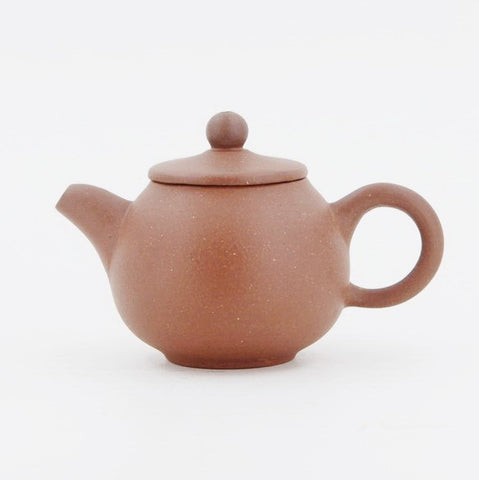
The shape of a teapot is said to have an effect on the flavour of the tea, with different shapes of teapots accommodating the different shapes, sizes and expansion rates of tea leaves. Here are some well known shapes:
Chart: Teapot Shapes by Type of Tea
 |
 |
|
Taiwan Oolong (High Profile)
|
Green/White Tea (High Profile)
|
 |
 |
|
Tie Guan Yin (Gun Yam, Iron Buddha,
Chinese Oolong, Buddha of Mercy) (Low Profile) |
Chinese Black Tea (known as Red Tea in China)
Pu-Erh (Bow Lay) (High Profile) |
 |
 |
|
Da Hong Pao (Cliff Tea) & Phoenix Tea (Low Profile)
|
A Decorative Teapot (Low Profile)
|
- Finest quality new high-fired teapots have a clear and distinct ring like a little bell when you lift up the lid about a quarter of an inch and allow it to drop gently on to the teapot (make sure you are holding the teapot on the flat of your hand so it is not damping the teapot in any way). In most cases, the higher the pitch and the longer the ring, the finer the quality
- Teapots used for Pu-Erh tea are thicker and made from a more porous clay than other teapots and don’t have the distinctive bright ringing sound. These are selected by an examination of the clay which usually has a rougher texture than teapots used for other teas
- Older teapots have a distinctive patina from the infusion of tea oils and constant use which can dull the pitch. Many new teapots have a similar shine from a wax coating that is applied to protect the clay and make them look nice on the shelf. (see how to remove this coating below in Seasoning A New Teapot)
- If you like antiques, a Yixing teapot dating from the 1980’s, 1950’s or even late Qing Dynasty is a wonderful thing to own as they are often one-of-a-kind designs and older teapots are made from excellent clay. Some were made by very famous artists and can fetch big prices. Antique teapots have a history (verifiable or not) and have been infused with tea oils over many years. They can give a decided “thunk” rather than a clear ring because of the accumulation of oils in the clay but can still be of the finest quality. But remember, you are in the antique game now so buyer beware!
- Always pour any extra tea you might have over your teapot and give it an occasional polish with a soft dry cloth. This will help to build up the oils in your teapot, allowing it to contribute its own unique “taste” and gives the teapot a nice shine
- Unfortunately, just about every teapot for sale is claimed to be a Yixing teapot, so in short, when buying a teapot, deal with an expert you can trust
With all this talk about high quality and antique teapots, there are excellent and inexpensive Yixing teapots for every budget and taste, from original handmade designs to mass produced ones that will make excellent tea and serve you for many years. For a full discussion on clay and Chinese teapots, see our guide: How to Choose A Chinese Teapot by Daniel Lui.
Advanced Brewing Technique
Tea experts know their craft so well that they only need to look at the tea leaves to determine the grade, how they should be brewed and how many brews a tea will yield. An expert will make the first brew and from that, determine how many seconds will be needed for the next brew and so on. Even the beginner can practice this way and if you keep detailed notes, you will develop your skill much faster.
The Quality Of Water
It is widely held among tea experts that fresh spring water provides just the right pH level, minerals and other elements that make the best tea. Just as coffee-makers have discovered, good water makes good tea. Experiment on your own and see the results for yourself.
There is another saying the Chinese have about the water for tea: “3 Times Boiled Is Dead Water”. This recognizes that water that is re-boiled more than 3 times has increased the ratio of the mineral content due to boil-off and has decreased the level of oxygen, both of which diminish the flavour of tea.
More Information
Check out our Library for extensive information about tea and tea making.
 Top of Page
Ask The Tea Wizard
Don't know which tea is right for you? Answer a few questions and the Online Wizard will show you all the Chinese teas that suit your taste.

